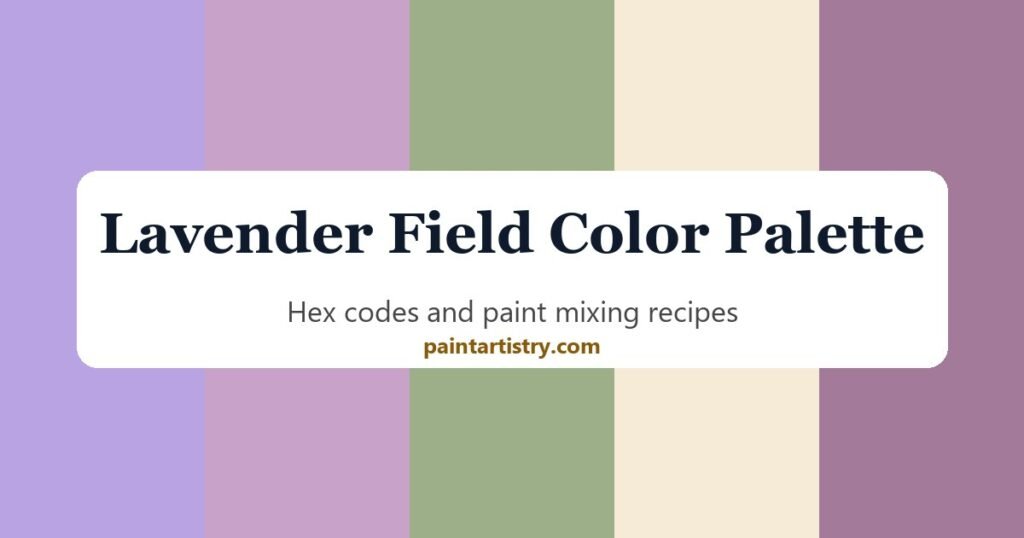
Purple in several strengths against gray-green leaves and a warm cream sky. Keep the edges soft and repeat the shapes in rows.
Our top pick for this project: Arteza Acrylic Paint Set, 60 Colors (affiliate link)
#B9A3E3#C8A2C8#9CAF88#F5EBD7#A37A9ALavender Field color palette: hex codes, RGB values and paint recipes
| Color | Hex | RGB | How to mix it |
|---|---|---|---|
| Lavender | #B9A3E3 |
185, 163, 227 | purple + white |
| Lilac | #C8A2C8 |
200, 162, 200 | purple + a lot of white + a touch of red |
| Sage Green | #9CAF88 |
156, 175, 136 | green + white + a touch of red |
| Cream | #F5EBD7 |
245, 235, 215 | white + a touch of yellow ochre |
| Mauve | #A37A9A |
163, 122, 154 | purple + white + a touch of gray |
Recipes use basic red, yellow, blue, white, black and brown. They are starting points: pigments vary by brand, so mix a little, test it on scrap paper and adjust by eye. In watercolor, lighten with water instead of white.
How to use this palette
A reliable way to balance five colors is the 60 / 30 / 10 rule. Use Lavender for roughly 60% of the picture, your main background or largest shape. Share about 30% between Lilac and Sage Green. Keep the last 10% for the accents, Cream and Mauve, where you want the eye to stop.
Ideas to paint with it:
- rows of lavender towards a farmhouse
- a single sprig in a glass jar
- a misty purple horizon
Painting tips for this palette
- This palette mixes warm and cool colors, so decide which should dominate. A 60 / 30 / 10 split keeps it balanced.
- Put colors that contrast strongly next to each other where you want the eye to land.
- Repeat each color at least twice around the painting so it feels connected, not scattered.
More color palettes you might like
Browse every palette on our color palettes page, build your own with the free palette generator, or print our free color mixing chart to keep next to your easel.