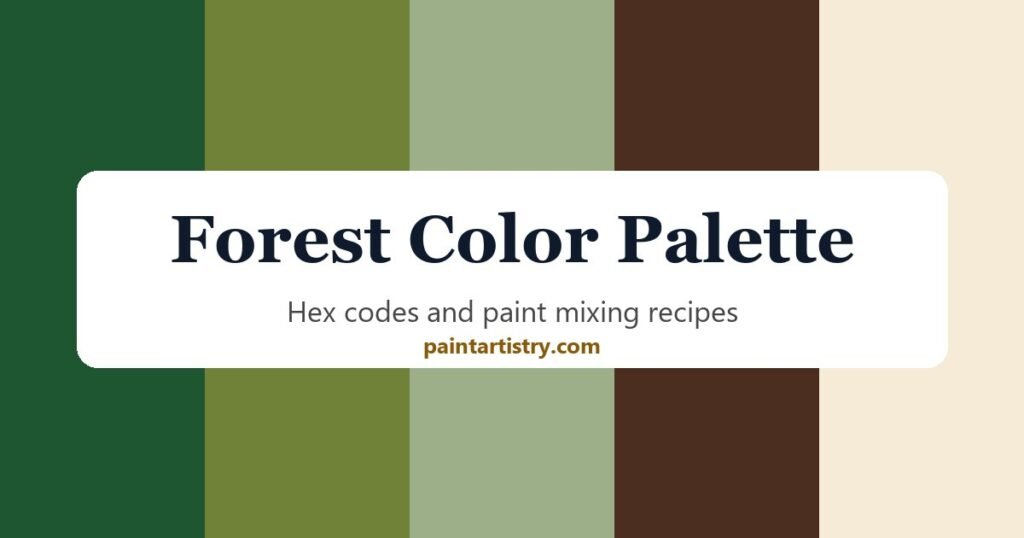
Layers of green from deep forest to pale sage, anchored by earthy brown. Use the darkest green for shadow and the lightest for sunlit leaves.
Our top pick for this project: Arteza Acrylic Paint Set, 60 Colors (affiliate link)
#1E5631#708238#9CAF88#4B2E1F#F5EBD7Forest color palette: hex codes, RGB values and paint recipes
| Color | Hex | RGB | How to mix it |
|---|---|---|---|
| Forest Green | #1E5631 |
30, 86, 49 | green + a little black or dark brown |
| Olive Green | #708238 |
112, 130, 56 | green + a touch of red or brown |
| Sage Green | #9CAF88 |
156, 175, 136 | green + white + a touch of red |
| Chocolate Brown | #4B2E1F |
75, 46, 31 | burnt umber + a touch of black |
| Cream | #F5EBD7 |
245, 235, 215 | white + a touch of yellow ochre |
Recipes use basic red, yellow, blue, white, black and brown. They are starting points: pigments vary by brand, so mix a little, test it on scrap paper and adjust by eye. In watercolor, lighten with water instead of white.
How to use this palette
A reliable way to balance five colors is the 60 / 30 / 10 rule. Use Forest Green for roughly 60% of the picture, your main background or largest shape. Share about 30% between Olive Green and Sage Green. Keep the last 10% for the accents, Chocolate Brown and Cream, where you want the eye to stop.
Ideas to paint with it:
- pine trees in morning mist
- a mossy woodland stream
- a close-up study of ferns
Painting tips for this palette
- This palette mixes warm and cool colors, so decide which should dominate. A 60 / 30 / 10 split keeps it balanced.
- Put colors that contrast strongly next to each other where you want the eye to land.
- Repeat each color at least twice around the painting so it feels connected, not scattered.
More color palettes you might like
Browse every palette on our color palettes page, build your own with the free palette generator, or print our free color mixing chart to keep next to your easel.