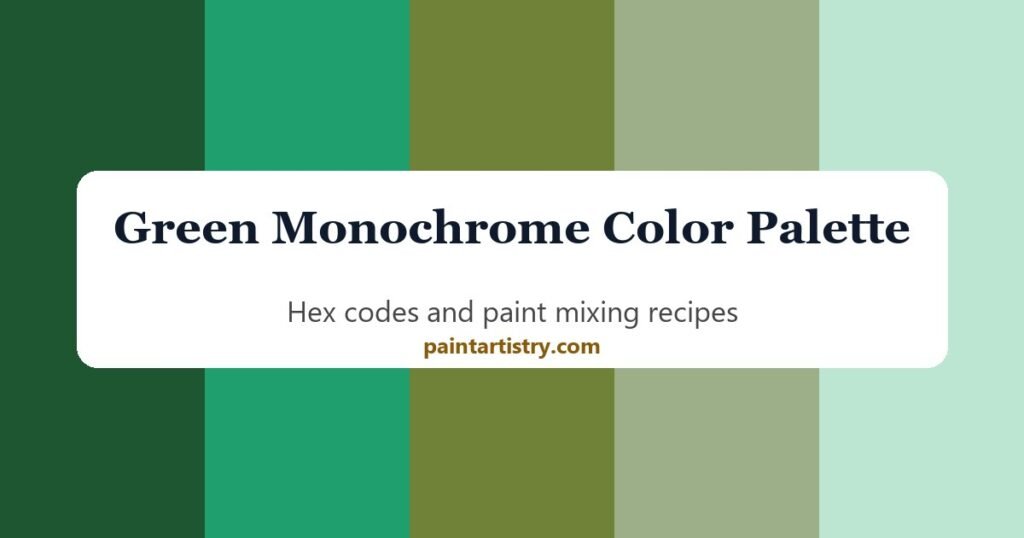
Five greens that range from deep forest to pale mint, with some cool and some warm. Painting in one hue trains you to see temperature and value.
Our top pick for this project: Arteza Acrylic Paint Set, 60 Colors (affiliate link)
#1E5631#1F9E6E#708238#9CAF88#BDE6D2Green Monochrome color palette: hex codes, RGB values and paint recipes
| Color | Hex | RGB | How to mix it |
|---|---|---|---|
| Forest Green | #1E5631 |
30, 86, 49 | green + a little black or dark brown |
| Emerald | #1F9E6E |
31, 158, 110 | green + a touch of blue |
| Olive Green | #708238 |
112, 130, 56 | green + a touch of red or brown |
| Sage Green | #9CAF88 |
156, 175, 136 | green + white + a touch of red |
| Mint | #BDE6D2 |
189, 230, 210 | white + a little green + a touch of blue |
Recipes use basic red, yellow, blue, white, black and brown. They are starting points: pigments vary by brand, so mix a little, test it on scrap paper and adjust by eye. In watercolor, lighten with water instead of white.
How to use this palette
A reliable way to balance five colors is the 60 / 30 / 10 rule. Use Forest Green for roughly 60% of the picture, your main background or largest shape. Share about 30% between Emerald and Olive Green. Keep the last 10% for the accents, Sage Green and Mint, where you want the eye to stop.
Ideas to paint with it:
- a botanical leaf study
- a hillside of trees receding into haze
- a green still life with pears and herbs
Painting tips for this palette
- This palette mixes warm and cool colors, so decide which should dominate. A 60 / 30 / 10 split keeps it balanced.
- Put colors that contrast strongly next to each other where you want the eye to land.
- Repeat each color at least twice around the painting so it feels connected, not scattered.
More color palettes you might like
Browse every palette on our color palettes page, build your own with the free palette generator, or print our free color mixing chart to keep next to your easel.