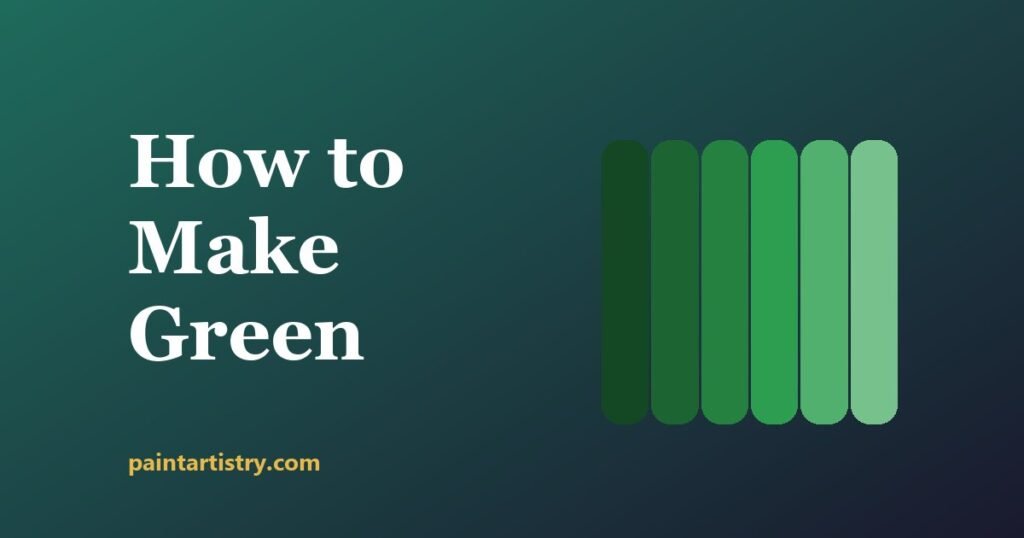
Green is simple to mix, since it is just yellow and blue, but getting the green you want takes a little pigment knowledge. The same two paints can give you a fresh spring green, a deep forest green or a dull olive, depending on which versions of yellow and blue you choose. This guide shows how to mix every kind of green, how to darken and tone it down without black, and how to keep it from looking chalky or artificial.
#9ACD32#5FCB6B#1F9E5A#2E5E3EQuick Answer: How to Make Green Paint
Mix yellow and blue. Start with mostly yellow and add blue a little at a time, because blue is much stronger and overwhelms yellow quickly. A rough starting point is 4 parts yellow to 1 part blue. More yellow gives a lighter, warmer lime or spring green, and more blue gives a deeper, cooler emerald or forest green.
Our top pick for this project: Arteza Acrylic Paint Set, 60 Colors (affiliate link)
Why Your Green Sometimes Looks Dull
Every primary leans slightly toward one of its neighbors on the color wheel. For a vivid green you need a yellow and a blue that both lean toward green. The versions that lean toward red contain a little of it, and red is green’s opposite, so it dulls the mix.
| Pair | Result |
|---|---|
| Cool yellow (lemon yellow) + cool blue (phthalo blue or cerulean) | Bright, clean, vivid green |
| Warm yellow (cadmium yellow) + cool blue | Warm, fairly bright green |
| Cool yellow + warm blue (ultramarine, which leans toward violet) | Slightly muted green |
| Warm yellow + warm blue | Muted, olive-leaning green |
This is the same reason colors turn muddy when you pick the wrong primaries.
A Palette of Greens
| Green | Approximate mix |
|---|---|
| Lime green | Lemon yellow + a tiny amount of phthalo blue |
| Spring green | Lemon yellow + a little cerulean blue |
| Emerald green | Phthalo blue + lemon yellow, with more blue |
| Forest green | Ultramarine + cadmium yellow, plus a touch of red or brown |
| Olive green | Cadmium yellow + ultramarine + a speck of red |
| Sage green | A mid green + white + a touch of red or gray |
| Teal | Phthalo blue + a little yellow, plus white for lighter teals |
| Mint | A bright green + plenty of white |
How to Mix Green Step by Step
- Put out a pool of yellow. It is the weaker color, so it makes the base.
- Add a very small amount of blue on the tip of a palette knife and mix thoroughly.
- Check the color on white paper. Keep adding blue a little at a time until you reach the green you want.
- If the green looks dull, check your pair of primaries. A warm yellow with a warm blue is the usual cause.
- Mix more than you need, since greens are hard to match twice.
Green Shades and Variations
| Shade | Approx. hex | How to mix it |
|---|---|---|
| Lime | #9ACD32 |
lemon yellow + a tiny amount of blue |
| Spring green | #5FCB6B |
lemon yellow + cerulean blue |
| Emerald | #1F9E5A |
phthalo blue + more yellow |
| Forest green | #2E5E3E |
ultramarine + cadmium yellow + a touch of red |
| Olive | #708238 |
yellow + ultramarine + a speck of red |
| Sage | #9CAF88 |
green + white + a touch of red or gray |
Pigments vary by brand, so treat every recipe as a starting point: mix a small amount, test it on scrap paper and adjust by eye. The hex codes are approximate screen colors. In watercolor, lighten with water instead of white.
How to Darken Green Without Black
Black deadens green and often makes it look sooty. Better ways to deepen it:
- Add more blue for a cooler, deeper green.
- Add a small amount of red, green’s opposite, which darkens and softens in one move.
- Add a dark earth color such as burnt umber for natural shadows.
How to Tone Down a Green That Is Too Bright
Raw mixed greens can look artificial in landscapes. Add a touch of red, the complement of green. A small amount neutralizes the green and creates natural-looking foliage tones. Add it gradually, because it is easy to overshoot into brown. See the complementary color technique for more.
Lighten Green Without Chalkiness
White lightens green but can make it look pastel and chalky. To keep life in the color, lighten by adding more yellow instead, or mix in white and a small amount of yellow together. For distant hills, add a little blue plus white to push greens back in space, as covered in color temperature in painting.
Mixing Green in Different Paints
- Acrylic: greens can dry slightly darker, so mix a shade lighter than you want. Phthalo blue is strong, so start with a very small amount.
- Oil: greens blend smoothly in oil. Glaze a thin blue over yellow, or the reverse, for luminous results.
- Gouache: opaque and matte, so gouache gives flat, even greens. Test a swatch dry, because gouache can shift.
- Watercolor: layer a yellow wash and a blue wash, or mix them in the well. Layering keeps greens fresh and varied.
Is a Tube of Green Worth Buying?
Mixing gives you the most control, but a couple of ready-made greens such as sap green or viridian are handy shortcuts for landscapes. Many acrylic paint sets and watercolor sets include them. (Affiliate links; we earn a small commission from qualifying purchases at no cost to you.)
Common Mistakes When Mixing Green
- Starting with blue. Blue overwhelms yellow quickly. Start with yellow and add blue slowly.
- Using warm primaries and expecting a vivid green. The hidden red dulls the mix.
- Darkening with black. It turns green sooty. Use blue, red or burnt umber.
- Too much white. It makes green chalky. Add yellow back in.
- Not testing on paper. Greens look different dry.
Practice Exercise
Take one cool yellow, one warm yellow, one cool blue and one warm blue. Mix every yellow with every blue (four greens), then add white and a drop of red to each. You will see on a single sheet how much range four colors can make.
Green Paint FAQ
What two colors make green?
Yellow and blue. Use a cool yellow and a cool blue for the brightest green.
How do I make dark green?
Add more blue, a touch of red, or burnt umber. Avoid black, which makes green look sooty.
How do I make light green?
Add more yellow, or a little white. Too much white can look chalky.
How do I make green without yellow?
You need some yellow. Cyan-like blues such as phthalo and cerulean are the closest to green and need only a little yellow.
Why does my green look brown or dull?
A warm yellow and warm blue contain red, which dulls green. Use cool primaries, and avoid adding too much of any dark color.
Keep Mixing
- How to make olive green paint
- How to make sage green paint
- How to make mint green paint
- How to make teal turquoise paint
- How to make brown paint
- Forest color palette
Keep our color mixing chart handy, grab the free printable version, or browse more color palettes.